
How to Look at a Card for the First Time
Read the video transcript
Before you ask what a card means, look at what’s really there. The meaning grows from the picture. The Four of Cups: arms folded, a fourth cup offered.
“Arms folded” you can see. “Bored” you read into it. Scan in order: the edges, then the objects, then the figures, and finally the colours.
The Eight of Cups: a night sky, eight stacked cups, and a figure in red walking away. The Six of Swords: a boat crossing the water, six swords standing inside, rough water turning calm. Ask what the card doesn’t tell you.
Who are these travellers? Where are they going? Notice one detail, and the reading changes.
Every good reading points back to something real. Feeling stuck? They stare at three cups, while a fourth arrives from the side.
What haven’t you seen? So, look before you interpret. Name what you see, notice what’s missing, and let every meaning point back to the picture.
This might be the most important habit in the whole course. Before you think about what a card means, look at what’s actually there. Readers who look first see far more, and their readings hold up better.
Most beginners reach for the meaning first. They see a card, remember a keyword, and stop looking. But every card is a small scene, full of people, objects and colours, and the scene is where the meaning comes from. Learn to look, and you’ll never be stuck with a card you haven’t memorised.
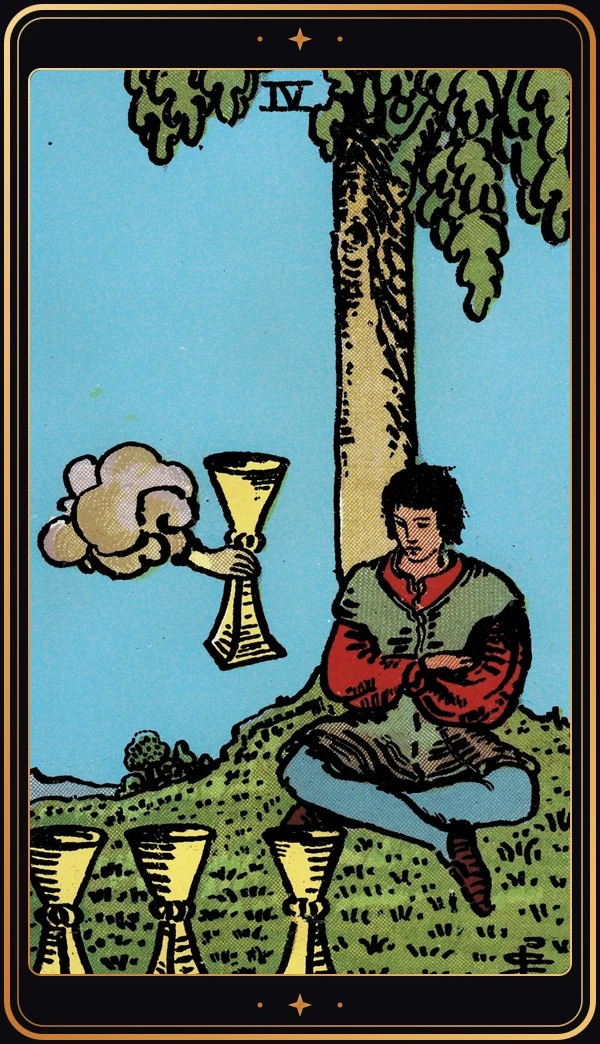
Take the Four of Cups. Don’t name its meaning yet. What do you see? A young figure sits under a tree with arms folded. Three cups stand on the grass in front of them. A hand comes out of a cloud on the left, offering a fourth cup. The figure’s eyes seem lowered.
Notice the language there. “Arms folded” is an observation: you can point to it. “Bored” or “ungrateful” would be interpretations: you’re reading them into the picture. Both have a place, but they belong in different columns. When you mix them too early, you stop seeing and start guessing.
A simple scan helps. Start with the edges: sky, ground, background. Then the objects. Then the figures: posture, hands, where they’re looking. Finally, colours. Name each thing plainly, as if describing the card to someone on the phone who can’t see it.
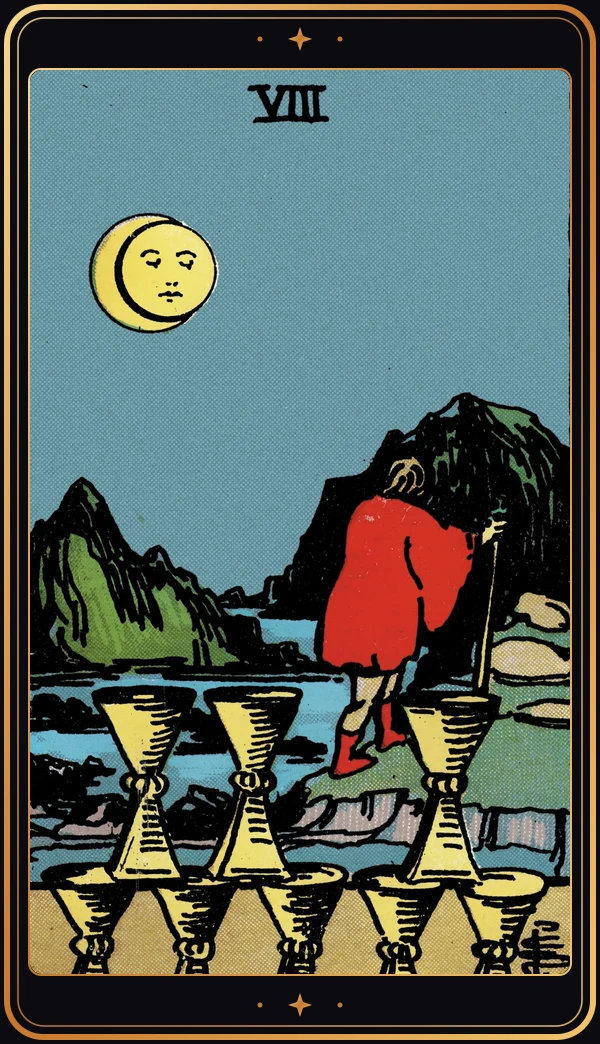
Try the scan on the Eight of Cups. Edges: a night sky, a moon with a face, rocky hills. Objects: eight cups stacked in two rows, with a gap in the top row. Figure: a person in a red cloak with a staff, walking away from the cups, their back to us. Colours: deep blues and a single warm red. You’ve described the whole card without a single meaning.
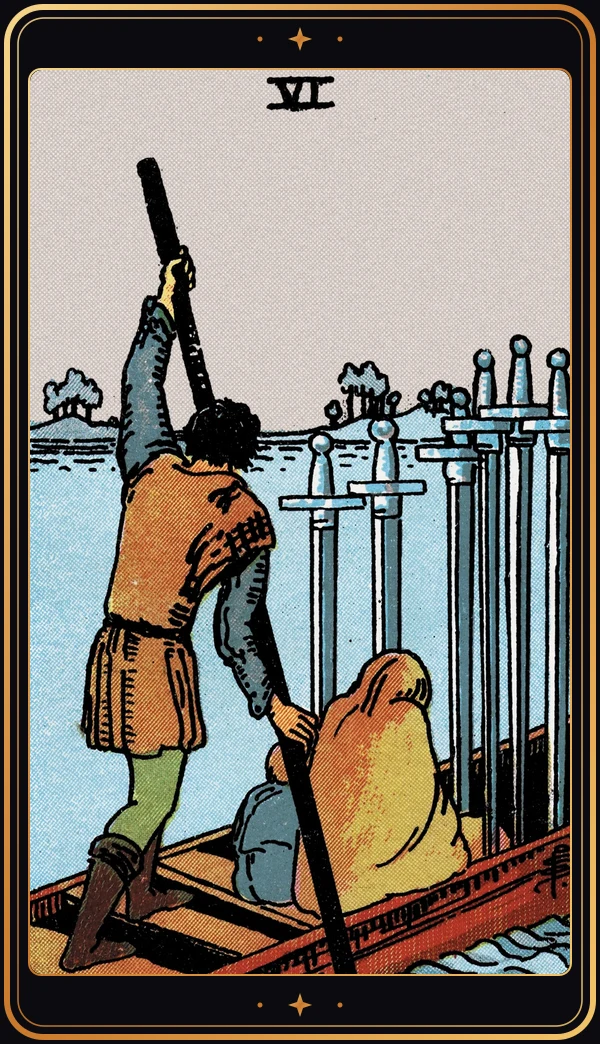
Now the Six of Swords. A figure stands at the back of a small boat, pushing it across the water with a pole. In front of them sit a cloaked adult and a child. Six swords stand upright in the boat. The water is rough on one side and smooth on the other, and there’s land in the distance.
Ask questions as you go. Has the figure in the Four of Cups noticed the cup from the cloud? Is the traveller in the Eight of Cups leaving for good, or looking for something? Who are the passengers in the Six of Swords? The cards don’t say. Questions like these keep you honest about what the image actually shows.
Small details can change a reading. In the Six of Swords, if you notice the rough water giving way to calm, you might read a move towards quieter times. If you notice the swords standing in the boat, you might read something difficult that’s being carried along. Both readings grow out of real details, and that’s what makes them worth trusting.
Only once you’ve described the card should you ask what it might suggest. Then point to the detail that led you there. You’ll find your interpretations are richer and better grounded when they grow out of what you can actually see.
Your exercise
Practise telling seeing from reading. For each statement about a card, decide: can you see it, are you reading it into the card, or isn’t it on the card at all? You’ll see straight away if you’re right.
Key takeaways
- 1Look before you interpret: the scene is where the meaning comes from.
- 2An observation is something you can point to; an interpretation is something you read into it.
- 3Scan in a steady order: edges, objects, figures, then colours.
- 4Ask what the card doesn’t tell you, so you don’t fill the gaps by guessing.
- 5A good interpretation can always point back to a real detail.